
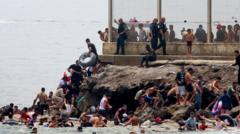

MADRID AND RABAT — The rugged coastline of the Strait of Gibraltar has once again laid bare the volatile intersection of European migration policy, African economic desperation, and complex geopolitical leverage. In recent hours, the Spanish autonomous enclave of Ceuta on the North African coast has become the epicenter of an unprecedented humanitarian emergency, as thousands of migrants breached the border barriers, swimming around breakwaters or wading through shallow coastal waters in scenes of utter chaos. Tragically, the perilous endeavor has already claimed lives, with authorities confirming at least 18 fatalities among those who attempted the treacherous maritime crossing. In response to the crisis, the Spanish government has mobilized its military, deploying troops to the border zone to reinforce the Guardia Civil and local police forces, while diplomatic channels between Madrid and Rabat face mounting strain over the underlying causes and management of the sudden influx.
For Sierra Leo News Network, this unfolding crisis demands rigorous examination not merely as an isolated border security incident, but as a symptom of deeper, systemic pressures that define contemporary migration dynamics in the Mediterranean basin. The events in Ceuta represent a dangerous convergence of international relations, socio-economic disparities, and human vulnerability, requiring an exhaustive analysis of the historical context, economic implications, political repercussions, and the future trajectory of European Union borders in North Africa.
Historical Background of Ceuta and Melilla
To understand the gravity of the current situation in Ceuta, one must first examine the unique geopolitical status of Spain's North African territories. Alongside Melilla, Ceuta is one of the two permanently inhabited Spanish cities situated on the mainland of the African continent. Bordering Morocco, these enclaves represent the only land boundaries shared between the European Union and the African continent. This geographical reality has transformed them into magnets for individuals fleeing poverty, conflict, and political instability across Sub-Saharan Africa and the broader Middle East.
The history of Ceuta dates back centuries, changing hands through various empires—from the Carthaginians and Romans to the Visigoths, Byzantines, and Umayyad Muslims—before coming under Portuguese control in the fifteenth century and subsequently passing to the Spanish Crown in 1680. For centuries, the city functioned primarily as a military garrison and a trading post. However, in the latter half of the twentieth century and accelerating into the twenty-first, Ceuta transformed into a frontline frontier of European migration enforcement.
The border separating Ceuta from Morocco is heavily fortified, featuring a perimeter made up of double-fences stretching several meters high, topped with barbed wire, and monitored by advanced surveillance technology, including thermal imaging cameras, motion sensors, and closed-circuit television networks. Despite these formidable physical deterrents, desperate individuals have consistently sought to bypass the barriers, either by scaling the fences en masse or by attempting dangerous sea crossings around the maritime borders at the Tarajal and Benzú beaches. Historically, migration flows fluctuate in response to seasonal weather patterns, increased enforcement along alternative routes (such as the Central Mediterranean route from Libya to Italy), and, crucially, the shifting diplomatic ties between Spain and Morocco.
The Anatomy of the Current Crisis
The latest surge in Ceuta began with an unprecedented volume of arrivals over a remarkably compressed timeframe. Eyewitness accounts and preliminary reports from the ground describe scenes of profound desperation. Thousands of people, including a significant number of minors and family units, took advantage of a perceived relaxation of surveillance on the Moroccan side of the border to cross into Spanish territory. Many discarded their belongings and plunged directly into the turbulent waters of the Atlantic, attempting to swim around the marine breakwaters that mark the boundary between Moroccan and Spanish jurisdictions.
The human cost of this desperate rush has been devastating. Emergency services, marine rescue units, and the Spanish Red Cross were quickly overwhelmed by the sheer scale of the arrivals. Search and rescue operations recovered at least 18 bodies from the coastal waters, while hundreds of others were treated for hypothermia, exhaustion, and minor injuries sustained while navigating the rocky shoreline and razor-wire-laced barriers. Local hospitals and temporary reception centers rapidly reached maximum capacity, forcing authorities to establish makeshift shelters in sports complexes and industrial warehouses.
The speed and coordination of the movement strongly suggest underlying systemic factors rather than a spontaneous, unorganized rush. Security analysts point out that border enforcement on the Moroccan side appeared uncharacteristically lax in the hours leading up to the mass crossing, prompting immediate speculation regarding the diplomatic friction between Madrid and Rabat. While bilateral cooperation between Spain and Morocco has traditionally served as the primary mechanism for curbing irregular migration, tensions often manifest on the ground when political disagreements arise between the two capitals.
Geopolitical Tensions and the Role of Morocco
The relationship between Spain and Morocco is complex, characterized by deep economic interdependence, security cooperation, and occasional diplomatic friction. Rabat has long maintained a formal stance that it does not recognize Spanish sovereignty over Ceuta and Melilla, viewing them as occupied territories within its national boundaries. Nevertheless, practical governance has required both nations to maintain a working alliance, particularly regarding counter-terrorism, intelligence sharing, and migration management.
In recent years, migration control has increasingly become a strategic lever in international diplomacy. Morocco acts as a crucial gatekeeper for Europe's southern border. In exchange for financial assistance, technical equipment, and political goodwill from Madrid and Brussels, Rabat has historically deployed its security forces to deter migrants from gathering near the border enclaves and to intercept vessels attempting to cross the Mediterranean. However, when bilateral relations sour—such as disputes over diplomatic receptions of political dissidents, maritime boundary delimitations, or policy stances on the disputed territory of Western Sahara—the enforcement posture of Moroccan border guards has occasionally shifted.
While official statements from Rabat often emphasize the immense financial and logistical burden of policing thousands of migrants within its borders, international observers frequently interpret fluctuations in migration flows as a calculated diplomatic signal. By temporarily easing border surveillance, authorities in transit countries can effectively compel European capitals to pay closer attention to their strategic priorities and demands for aid or political support. The events in Ceuta must therefore be viewed through this geopolitical lens, where vulnerable human beings are caught in the crossfire of high-stakes statecraft.
The Response from Madrid: Militarization of the Border
Faced with an unprecedented humanitarian and security challenge, the Spanish government in Madrid reacted swiftly. Prime Minister Pedro Sánchez canceled a scheduled international engagement to manage the crisis directly, convening emergency cabinet meetings and announcing the immediate deployment of the Spanish Armed Forces to support the civil authorities in Ceuta.
The deployment of military personnel to an international border is a significant step, underlining the gravity with which Madrid views the situation. Units from the Spanish Army, already stationed in the enclave, were mobilized to patrol the perimeter fences alongside the Guardia Civil and the National Police. Military engineers and logistics personnel were tasked with reinforcing temporary reception structures and assisting with medical triage. Simultaneously, the Spanish government initiated immediate diplomatic outreach to Rabat, demanding explanations and calling for the immediate resumption of standard border controls and the repatriation of individuals who crossed irregularly.
Under bilateral readmission agreements, Spain possesses the legal framework to return adult migrants who cross the border clandestinely. However, the sheer volume of arrivals has created severe logistical bottlenecks. Furthermore, international human rights law and Spanish domestic legislation impose strict protocols regarding the processing of asylum claims and the protection of unaccompanied minors, complicating rapid mass expulsions. Legal experts and human rights organizations have closely monitored the deployment, warning that the militarization of border management risks escalating tensions and prioritizing security optics over humanitarian obligations.
Critics from various political spectrums in Spain have voiced divergent concerns. Conservative opposition parties have accused the government of projecting weakness on national security and failing to maintain absolute territorial integrity. Conversely, progressive factions and humanitarian NGOs have condemned the use of military forces for civilian border policing, arguing that securitized responses fail to address the root causes of migration and expose desperate individuals to extreme physical danger.
Economic, Social, and Humanitarian Implications
The local impact of the crisis on the city of Ceuta itself is profound. With a population of approximately 85,000 residents compressed into a relatively small geographical area of just 18.5 square kilometers, the sudden influx of thousands of migrants exerts immense pressure on local infrastructure, healthcare services, and municipal finances.
Ceuta’s economy has historically relied on cross-border trade, tourism, and services. The closure of the border with Morocco in recent years—first precipitated by the COVID-19 pandemic and subsequently sustained by political disputes—had already devastated local commerce, ending the lucrative practice of cross-border "optimized trading" where goods were transported across the frontier by porters. The latest crisis further exacerbates economic uncertainty, transforming the enclave into an isolated zone of intense logistical and humanitarian strain.
Humanitarian organizations operating on the ground have highlighted the immense psychological and physical trauma experienced by those who made the crossing. Many survivors endured weeks or months of hardship traveling across the Sahara Desert and through Morocco before reaching the coast. The decision to brave the open sea in hazardous conditions—often without adequate swimming skills or safety equipment—underscores the depth of despair driving these populations. When individuals perceive that their prospects in their countries of origin or transit are entirely closed, the perceived risks of maritime and border crossings become secondary to the desperate pursuit of survival and dignity.
The Broader European Context and Regional Stability
While Ceuta is a Spanish territory, the crisis reverberates far beyond Madrid, landing squarely on the doorstep of the European Union. Brussels has consistently grappled with the formulation of a cohesive, humane, and effective common migration and asylum policy. Incidents in peripheral border zones like Ceuta, the Canary Islands, and the Greek islands of the Aegean Sea repeatedly expose the deep fractures within the bloc regarding burden-sharing, solidarity, and external border management.
European Commission officials have expressed solidarity with Spain, reiterating that Ceuta's border is an external border of the entire European Union. However, long-standing disagreements among member states regarding mandatory relocation mechanisms for asylum seekers continue to paralyze comprehensive reform. Frontline states like Spain, Italy, Greece, and Malta frequently argue that they shoulder an unfair proportion of the processing and hosting responsibilities, while northern and eastern member states resist mandatory quotas.
Beyond internal EU politics, the situation in Ceuta highlights the fragility of Europe's externalized migration governance model. For decades, the EU and its member states have increasingly relied on bilateral agreements with third-country governments—such as Turkey, Libya, Tunisia, and Morocco—to stem migration flows before they reach European territorial waters. While this approach has periodically succeeded in reducing arrival numbers, it creates structural vulnerabilities. Critics argue that it renders European migration policy hostage to the domestic political calculations and leverage of external partners, who can effectively utilize migration pressure as a diplomatic tool.
Expert Opinions and Strategic Assessments
Migration analysts and international relations experts offer sobering assessments of the Ceuta crisis, emphasizing that short-term security measures and military deployments provide only temporary containment rather than sustainable solutions.
Dr. Elena Vance, a senior researcher on Mediterranean geopolitics at the Institute for Strategic Studies, notes that physical barriers and military interventions address the symptom rather than the disease. "When economic disparity, political instability, and climate stressors drive populations to move, no fence high enough and no military deployment robust enough will permanently halt the flow," Vance observes. "What we witnessed in Ceuta is a predictable manifestation of structural inequalities compounded by fragile diplomatic partnerships. Until Europe and its African partners construct a holistic framework addressing legal pathways, economic development, and genuine cooperation, these cyclical crises will persist."
Similarly, migration economist Marcus Thorne emphasizes the financial dimension of border enforcement versus developmental aid. "The millions of euros funneled into surveillance technology and physical barriers in North Africa often yield diminishing returns," Thorne argues. "A redirection of resources toward sustainable economic investment, educational infrastructure, and lawful, regulated labor mobility models would yield far more stable and humane outcomes for both European economies facing demographic decline and African youth seeking viable futures."
Future Consequences and Policy Trajectories
As the immediate chaos in Ceuta subsides into managed processing and diplomatic negotiations, policymakers in Madrid, Rabat, and Brussels are forced to confront the long-term implications of the event. Several critical trajectories are likely to shape the post-crisis landscape:
First, diplomatic channels between Spain and Morocco will undergo intense calibration. Madrid will seek assurances that Rabat will restore strict border enforcement protocols, while Morocco will likely utilize the moment to press its own geopolitical interests, potentially seeking increased financial aid, enhanced trade concessions, or renewed diplomatic alignment on regional territorial disputes. The delicate balancing act of mutual dependency will be tested, but both capitals recognize that total rupture is untenable.
Second, the humanitarian infrastructure within Ceuta and mainland Spain will face prolonged strain. Processing thousands of new arrivals, determining asylum eligibility, managing the care of unaccompanied minors, and executing lawful returns under international human rights standards require immense administrative capacity and financial resources. The political fallout within Spanish domestic politics will also reverberate, likely fueling polarized debates surrounding immigration policy ahead of upcoming electoral cycles.
Third, at the broader European level, the crisis will reignite debates regarding the operational readiness of the EU’s external borders and the efficacy of the New Pact on Migration and Asylum. Member states will once again grapple with the tension between national sovereignty, border security mandates, and international humanitarian obligations under the Geneva Convention and European human rights law.
Ultimately, the tragic loss of at least 18 lives off the coast of Ceuta serves as a grim reminder of the human cost inherent in the failure of international governance systems to manage global mobility equitably and safely. Beyond the geopolitical maneuvering, the military deployments, and the diplomatic communiqués, the events in the North African enclave underscore a fundamental human reality: the enduring drive of individuals to risk everything in pursuit of safety, opportunity, and a better life. Until international policy evolves to address the structural drivers of this movement with vision, empathy, and strategic realism, the waters of the Strait of Gibraltar will remain a theatre of profound human tragedy and geopolitical vulnerability.