
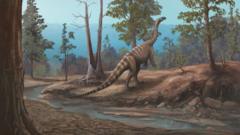

Paleontologists working in the rugged terrain of Zimbabwe have announced the formal identification of a brand-new dinosaur species, *Musango matusadonaensis*, a discovery that dramatically reshapes our understanding of prehistoric ecosystems in southern Africa and highlights the continent's profoundly under-explored fossil heritage.
The unearthing of this ancient creature, scientifically detailed in recent months, offers a fascinating glimpse into a world that existed roughly 210 million years ago during the Late Triassic epoch. Far from being merely a localized anatomical curiosity, the identification of *Musango matusadonaensis* provides critical data points for researchers attempting to reconstruct the assembly and eventual breakup of the supercontinent Pangea. As the global scientific community continues to re-evaluate the geographic distribution of early dinosaurs, this find firmly places southern Africa at the epicenter of early sauropodomorph evolution.
The journey from field excavation to formal classification is rarely straightforward, particularly in remote regions of sub-Saharan Africa. The fossils that would eventually define *Musango matusadonaensis* were recovered from the sedimentary rock formations of the Mid-Zambezi Basin, specifically near the breathtaking landscapes of the Matusadona region. This geographical context is not merely a footnote; it provides the species with its specific epithet and ties its evolutionary history directly to the dramatic tectonic and climatic shifts that characterized the Late Triassic period. For decades, paleontological efforts globally have been heavily skewed toward northern hemisphere discoveries, largely due to historical funding structures and institutional biases. However, finds such as this forcefully remind the scientific establishment of the extraordinary treasures locked within African sedimentary deposits.
Anatomical Profile and Evolutionary Significance
To understand the significance of *Musango matusadonaensis*, one must examine its place within the broader family tree of dinosaurs. The creature belongs to the sauropodomorph group, an iconic lineage of long-necked, long-tailed herbivores that would eventually evolve into the largest land animals to ever walk the Earth, including giants like *Brachiosaurus* and *Diplodocus*. However, during the Late Triassic, when *Musango matusadonaensis* roamed the earth, sauropodomorphs were in their evolutionary infancy.
Analysis of the recovered skeletal remains indicates that *Musango matusadonaensis* was a medium-sized herbivore, substantially smaller than its towering Cretaceous descendants, but formidable nonetheless in its ecological niche. By examining the bone structure, specifically the limb bones and vertebrae, researchers have been able to deduce vital information regarding its locomotion and posture. Unlike later sauropods which were strictly quadrupedal, early sauropodomorphs like this Zimbabwean specimen often exhibited transitional anatomical traits, showing adaptations that suggest a versatile ability to move between bipedal and quadrupedal postures as they navigated dense prehistoric vegetation.
Furthermore, dental morphology—the shape and wear patterns of the teeth—reveals that *Musango matusadonaensis* was uniquely adapted to process tough, fibrous plant material that dominated the Triassic landscape. The transition from the carnivory of ancestral archosaurs to the specialized herbivory seen in these early dinosaurs represents one of the most important dietary shifts in vertebrate history, fundamentally altering terrestrial food webs. The discovery in Zimbabwe provides an exceptionally well-preserved window into this transitional phase, showcasing anatomical adaptations that researchers had previously only theorized based on sparse fragments from other regions.
The Triassic Landscape of Southern Africa
Reconstructing the environment in which *Musango matusadonaensis* lived requires a radical reimagining of modern Zimbabwe's geography and climate. Two hundred and ten million years ago, the landmass that is now southern Africa was not an isolated continent with arid savannas and seasonal river systems. Instead, it was an integral, central component of Pangea, positioned much closer to the south pole than it is today, yet experiencing a vastly different climatic regime.
During the Late Triassic, the Mid-Zambezi Basin was characterized by extensive river systems, lush floodplains, and fluctuating water tables that supported a rich and diverse flora. Paleobotanical evidence from the same strata indicates a dominance of seed ferns, conifers, and early cycads, creating a dense understory interspersed with towering gymnosperms. This environment provided abundant sustenance for herbivorous dinosaurs, while also presenting unique ecological pressures, including seasonal monsoons and prolonged dry spells.
The preservation of *Musango matusadonaensis* within these ancient river deposits suggests that the animal may have lived, died, or been washed into these fluvial systems, where rapid sediment burial protected its remains from scavengers and destructive weathering forces. This taphonomic process—how the organism transitioned from a living animal to a fossilized specimen—is crucial for paleontologists. It explains the remarkable integrity of the bones and provides geologists with precise chronological markers. By studying the surrounding rock layers, scientists can date the fossils with high degrees of accuracy, ensuring that *Musango matusadonaensis* fits securely into the established timeline of vertebrate evolution.
Challenging Global Biogeographical Models
One of the most profound implications of the *Musango matusadonaensis* discovery lies in what it tells us about dinosaur distribution and diversity during the Triassic-Jurassic transition. For many years, a prevailing hypothesis in paleontology suggested a relatively homogenous distribution of early dinosaur fauna across Pangea. Because the supercontinent lacked physical barriers separating the northern and southern hemispheres, it was often assumed that the same few species roamed vast distances unchecked.
However, the continuous uncovering of distinct regional species in southern Africa—exemplified now by *Musango matusadonaensis*—shatters this monolithic view. It demonstrates that regional endemism was far more prevalent than previously suspected. Even without oceans dividing them, ecological barriers such as mountain ranges, extensive desert belts, and climatic gradients created distinct faunal provinces. Southern Africa, it appears, was a dynamic evolutionary hotspot, giving rise to specialized lineages that adapted specifically to the unique environmental conditions of the southern mid-latitudes.
This realization forces a comprehensive revision of global biogeographical models. Researchers must now account for why certain sauropodomorph lineages thrived in what is now Zimbabwe while completely different lineages dominated contemporary ecosystems in South America, Europe, or North America. These insights shed light on the resilience of dinosaur populations during times of global stress, offering clues as to how certain groups managed to survive the catastrophic End-Triassic extinction event while other major tetrad lineages perished.
Economic, Regional, and Infrastructural Implications
While the primary value of the *Musango matusadonaensis* discovery is undeniably scientific and academic, significant ripples extend into the socioeconomic sphere of Zimbabwe and the broader southern African region. Paleontological discoveries of this magnitude possess a unique capacity to stimulate local economies, boost educational infrastructure, and elevate national pride on the international stage.
In recent years, the intersection of science and sustainable tourism—often termed geotourism—has gained immense traction across developing nations. The Matusadona region, already celebrated for its breathtaking wildlife and natural beauty around Lake Kariba, now holds an additional, ancient claim to fame. By integrating deep-time heritage with contemporary ecological tourism, local communities stand to benefit from increased visitation by science enthusiasts, academic researchers, and culturally curious travelers.
Furthermore, high-profile discoveries serve as a powerful catalyst for educational development within the host country. Inspiring the next generation of African scientists, geologists, and paleontologists is critical for ensuring that the continent's rich fossil record is studied, preserved, and managed by local experts. Historically, much of Africa's paleontological heritage was removed by colonial-era expeditions and housed in European and North American museums. Today, the modern framework emphasizes in-country curation, collaborative international partnerships, and the development of local museum infrastructure to display and safeguard national treasures like the *Musango matusadonaensis* type specimen.
Expert Perspectives and the Methodology of Discovery
The painstaking work required to bring *Musango matusadonaensis* to light underscores the dedication of modern field paleontologists. Utilizing a combination of traditional excavation tools—chisels, rock hammers, and delicate dental picks—alongside advanced technological aids such as drone mapping, ground-penetrating radar, and 3D photogrammetry, research teams navigate harsh climates and rugged terrains to secure fragmentary evidence from the deep past.
Leading voices in the paleontological community have emphasized that finding a new dinosaur species is rarely a matter of stumbling upon a complete skeleton eroding out of a hillside. Rather, it is the culmination of years of systematic prospecting, geological mapping, and meticulous laboratory preparation. Once bones are extracted encased in protective plaster jackets, they undergo months or even years of careful preparation in museum basements, where technicians remove stubborn matrix rock from delicate fossil surfaces.
Specialists in Triassic ecosystems have pointed out that *Musango matusadonaensis* fills a crucial morphological gap. In comparative anatomy, discovering a transitional form is akin to finding a missing link in a chain of evolutionary events. The specific combination of primitive and derived features observed in this Zimbabwean dinosaur allows researchers to run more accurate phylogenetic analyses using complex computer algorithms. These analyses construct evolutionary trees with higher statistical confidence, ultimately resolving long-standing debates regarding the exact branching order of early dinosaur evolution.
Global Perspectives and Future Horizons in Paleontology
As the scientific paper detailing *Musango matusadonaensis* circulates through academic institutions worldwide, it is already prompting secondary waves of research. Paleontologists working in neighboring countries—such as Zambia, South Africa, and Mozambique—are revisiting their own regional collections and field sites, searching for homologous rock strata and complementary fossil materials. The collaborative nature of modern paleontology ensures that a discovery in Zimbabwe immediately informs studies being conducted thousands of miles away.
The global significance of African paleontology cannot be overstated. From the cradle of humankind studies in anthropology to the earliest records of dinosaur evolution, the African continent holds the keys to understanding major chapters of planetary history. Yet, funding constraints, political instability in various regions, and logistical hurdles often hamper comprehensive exploration. The success of the team behind the *Musango matusadonaensis* find serves as a testament to what can be achieved through perseverance, local-international collaboration, and institutional support.
Looking ahead, the future of research surrounding *Musango matusadonaensis* and its surrounding ecosystem is rich with possibilities. Advanced imaging techniques, such as synchrotron micro-tomography, may soon be applied to the fossilized bones to peer inside their microscopic structure, revealing details about the animal's growth rates, metabolic strategies, and physiological responses to environmental stress. Did these creatures experience rapid, mammalian-like growth spurts? How did they cope with seasonal fluctuations in food availability? These are the questions that will drive the next phase of investigation.
Ultimately, the formal naming of *Musango matusadonaensis* is far more than an addition to a taxonomic catalog. It is a profound reconnection with a lost world, a validation of the richness of Zimbabwe's geological heritage, and a powerful reminder of the dynamic, ever-changing nature of life on Earth. As researchers continue to comb the riverbeds and sedimentary basins of southern Africa, the story of *Musango matusadonaensis* stands as a beacon of discovery, promising that many more secrets of the deep prehistoric past remain buried beneath the African soil, waiting patiently to be uncovered.