
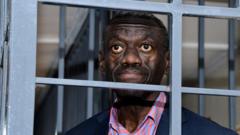

KAMPALA — In a dramatic and deeply concerning development that has sent immediate shockwaves across the East African political landscape, veteran Ugandan opposition leader Dr. Kizza Besigye collapsed inside a military courtroom, leading to his subsequent transfer to an intensive care unit. The 70-year-old stalwart of the country's pro-democracy movement, who has spent the entirety of his recent life challenging the entrenched status quo of President Yoweri Museveni’s administration, has been held in strict military detention since November 2024. Facing severe treason charges—allegations which he, his legal team, and his political allies vehemently deny—his sudden medical emergency brings long-standing concerns regarding human rights, the treatment of political prisoners, and the militarization of the Ugandan judiciary into sharp, inescapable global focus.
The news of Dr. Besigye’s collapse broke through a statement released by his wife, Winnie Byanyima, a prominent international civil servant serving as the Executive Director of UNAIDS. Speaking with grave concern, Ms. Byanyima detailed the terrifying moments leading up to her husband’s medical crisis within the courtroom setting, emphasizing the physical toll that months of arduous detention have taken on a septuagenarian whose opposition activism spans over three decades. The incident has not only galvanized his supporters on the ground in Kampala and across the diaspora but has also triggered frantic demands from international human rights monitors, diplomatic missions, and legal associations for immediate, transparent, and independent medical access.
As medical professionals scramble to stabilize the veteran politician, this crisis serves as a volatile flashpoint in Uganda's ongoing political saga. To understand the gravity of the current situation, one must look far beyond the immediate courtroom drama and examine the historical tapestry of resistance, the complex legal architecture governing military trials for civilians in Uganda, the profound economic ramifications of prolonged political instability, and the broader geopolitical chessboard upon which the Museveni administration operates.
This extensive report delves deep into the anatomy of the crisis, exploring the trajectory of Dr. Besigye's political career, the specifics of the current treason case against him, the systemic issues plaguing the Ugandan justice system, and the potential fallout for a nation teetering on the edge of a critical political transition.
The Historical Trajectory of Resistance: Decades of Confrontation
To contextualize the gravity of Dr. Kizza Besigye’s current detention and medical collapse, one must reexamine a political journey that has been inextricably linked to the modern history of the Ugandan state. Born in the Western region of Uganda, Besigye initially trained as a physician, a background that eventually led him to serve as a medical doctor for the National Resistance Army (NRA) during the protracted guerrilla war led by Yoweri Museveni in the early 1980s. That war successfully overthrew the regime of Milton Obote and brought Museveni to power in 1986.
In those formative post-war years, Besigye was not merely an ally; he was part of the inner circle, serving in various high-profile government and military capacities, including as national political commissar and minister of state for internal affairs. However, ideological divergence began to fracture the ruling elite by the late 1990s. Besigye grew increasingly vocal about what he perceived as a betrayal of the original democratic ideals of the revolution. He openly criticized the burgeoning authoritarianism, systemic corruption, and the entrenchment of personal rule under his former commander.
The definitive break occurred in the year 2000, when Besigye published a scathing critique of the National Resistance Movement (NRM), declaring that the organization had abandoned its foundational principles. This act of defiance set the stage for the 2001 presidential election, where Besigye took the extraordinary step of running against his former patron, President Museveni. It was a watershed moment in Ugandan politics, introducing the concept of a viable, organized domestic electoral challenge to an incumbent who had previously consolidated power through revolutionary legitimacy.
Over the subsequent two decades, Besigye became the perennial face of Ugandan opposition politics. He contested the presidency four times—in 2001, 2006, 2011, and 2016. Each electoral cycle was marked by mounting state resistance, allegations of widespread vote rigging, violent crackdowns on opposition rallies, and numerous instances of Besigye being placed under preventive house arrest, teargassed, or imprisoned. Despite these continuous setbacks, he maintained a profound grassroots following, particularly among urban youth and economically disenfranchised populations who viewed him as an unwavering symbol of resilience against a seemingly immovable political establishment.
The Anatomy of the Current Detention: November 2024 and Beyond
The latest chapter in this protracted political struggle opened abruptly in November 2024, when Dr. Besigye was reported missing while abroad in a neighboring East African nation, only to subsequently reappear inside a military detention facility in Uganda. The manner of his apprehension raised immediate legal and ethical alarms among human rights organizations, who characterized the operation as an extrajudicial rendition and an outright violation of international norms regarding sovereignty and due process.
Following his clandestine transfer back to Ugandan soil, Besigye was formally arraigned before a military court-martial. The decision to try a civilian—albeit a retired military officer—before a military tribunal has been a cornerstone of the state's legal strategy against prominent opposition figures, yet it remains intensely controversial. Constitutional lawyers and human rights defenders have repeatedly argued that trying civilians in military courts violates the fundamental tenets of a fair trial, separation of powers, and constitutional guarantees enshrined in the 1995 Ugandan Constitution.
The charges brought against him—chief among them being treason—carry the ultimate legal penalties under Ugandan law, including the death penalty or life imprisonment. Prosecutors allege actions and associations intended to compromise the security of the state and overthrow the government by unlawful means. Besigye and his legal team have consistently rejected these accusations as entirely politically motivated fabrications designed to permanently neutralize his political influence and silence his persistent critiques of governance, corruption, and economic mismanagement.
The months spent in detention since November 2024 have reportedly taken a severe toll on his health. Friends, family, and lawyers who have managed to secure brief visits have frequently noted signs of physical decline, exacerbated by the psychological strain of solitary or highly restrictive confinement conditions characteristic of maximum-security military facilities. The culmination of these compounding factors manifested in the courtroom collapse, transforming what was already a contentious legal proceeding into a critical humanitarian emergency.
The Legal and Institutional Battlefield: Military Courts and Civil Liberties
The decision to subject Dr. Besigye to military jurisdiction illuminates a broader, deeply entrenched structural issue within the Ugandan legal framework: the utilization of military tribunals to adjudicate cases involving civilian political actors. This practice has long been a focal point of criticism from both domestic civil society organizations and international judicial watchdogs, who point to the inherent conflict of interest and lack of institutional independence within military courts.
Under Ugandan law, the General Court Martial operates under the direct purview of the military hierarchy, whose ultimate commander-in-chief is none other than President Yoweri Museveni himself. Consequently, when an opposition leader accused of treason against the sitting government is tried within this specific judicial arm, the appearance of executive interference is difficult to dismiss. Legal scholars argue that such trials bypass the ordinary civilian criminal justice system, where procedural safeguards, public transparency, and rights of appeal are more robustly defined.
Furthermore, the application of treason charges in political contexts has historical precedents in Uganda that evoke dark memories of past authoritarian regimes. Treason is defined broadly enough in the penal code to encompass various forms of intense political opposition, protests, and civil disobedience. By casting political dissent as a treasonous security threat, the state effectively criminalizes opposition politics, raising the political stakes to existential levels for anyone daring to challenge the administration.
The courtroom collapse of a 70-year-old detainee under these circumstances places the spotlight directly on the conditions of confinement. International standards, including the United Nations Standard Minimum Rules for the Treatment of Prisoners (the Nelson Mandela Rules), mandate that all detainees must be provided with adequate medical care and humane conditions. The failure to ensure timely preventative medical intervention for a high-profile political prisoner inevitably invites domestic and global condemnation, questioning the state’s adherence to its own constitutional obligations and international human rights treaties.
Economic Implications: Stability, Investment, and Political Risk
While the immediate drama of Dr. Besigye’s health crisis plays out in a medical facility, the ramifications extend far beyond the legal and political spheres, deeply touching Uganda's economic landscape. Political stability is a foundational prerequisite for sustainable economic development, foreign direct investment (FDI), and international financial partnerships. Episodes of acute political turbulence, particularly those involving the mistreatment or severe illness of iconic opposition figures, introduce high levels of systemic risk that foreign investors and multilateral lenders monitor closely.
Uganda’s economy has experienced steady growth in sectors such as agriculture, services, and the burgeoning oil and gas industry—particularly centered around the upcoming commercial extraction of Lake Albert crude oil reserves. However, the realization of long-term economic prosperity depends heavily on predictable governance, the rule of law, and a stable sociopolitical environment. When domestic tension escalates, as it has following the November 2024 arrest and subsequent medical emergency of Besigye, the perception of country risk rises commensurately.
International credit rating agencies and development finance institutions frequently incorporate governance indicators—including political stability, control of corruption, and the protection of civil liberties—into their assessments. Heightened domestic unrest, street protests, and heavy-handed police responses can disrupt commercial activity, damage urban infrastructure, and deter tourism. Furthermore, bilateral donors and Western partners frequently utilize aid conditionalities linked to human rights performance. A worsening human rights climate risks provoking diplomatic friction, potential aid freezes, or targeted sanctions, which can exert downward pressure on public finances and currency stability.
Beyond macroeconomic indicators, the prolonged suppression of political opposition stifles the vital flow of ideas and policy debate necessary for robust economic planning. A system that continuously sidelines alternative leadership voices risks creating an echo chamber of governance, potentially missing innovative solutions to pressing socio-economic challenges such as high youth unemployment, inflationary pressures, and infrastructure deficits.
Regional and Global Perspectives: East African Diplomacy and International Pressure
The unfolding crisis involving Dr. Besigye does not occur in a vacuum; it resonates deeply across the East African Community (EAC) and draws the anxious gaze of the international community. Uganda plays a pivotal, strategic role in regional geopolitics. Kampala acts as a critical anchor for security operations, peacekeeping initiatives, and economic corridors connecting landlocked nations like Rwanda, the Democratic Republic of Congo, and South Sudan to the maritime ports of the Indian Ocean.
Consequently, regional leaders often tread a delicate diplomatic tightrope. On one hand, the principle of non-interference in the internal affairs of sovereign member states governs much of regional diplomacy within the EAC and the African Union (AU). On the other hand, prolonged instability in Uganda carries the potential for spillover effects, including refugee flows, economic disruption along key transit routes, and heightened regional insecurity.
Globally, traditional Western partners—including the United States, the United Kingdom, and the European Union—find themselves managing a complex diplomatic dilemma. Uganda remains an indispensable partner in regional counterterrorism efforts, particularly regarding peacekeeping operations against extremist groups in Somalia and maintaining fragile stabilities in the Great Lakes region. However, these strategic imperatives often clash with foundational foreign policy commitments to democracy, human rights, and the rule of law.
In the wake of Besigye’s collapse, international diplomatic missions in Kampala are expected to intensify pressure on the Ugandan government to ensure his unconditional access to independent medical specialists of his choice, fair and transparent legal proceedings, and humane treatment while in custody. Past precedents suggest that while direct diplomatic rebukes may be measured, quiet behind-the-scenes lobbying by foreign envoys often plays a crucial role in moderating the excesses of state action against high-profile political detainees.
Expert Analyses and Sociological Impact: The Mood on the Streets of Kampala
To gauge the deeper sociological impact of this event, political analysts and sociologists point to the profound generational divide in Uganda. President Museveni’s administration has been in power for nearly four decades. This means that the vast majority of Uganda’s population—where the median age hovers around fifteen years—has known no other president. For this young demographic, historical narratives of the 1986 liberation struggle hold diminishing emotional resonance, replaced instead by immediate, pressing concerns over jobs, cost of living, and political freedom.
Dr. Kizza Besigye, despite his long tenure in opposition, has successfully maintained an image of unwavering defiance that resonates powerfully with urban youth who feel alienated by economic stagnation and limited upward mobility. His periodic arrests and physical suffering have frequently served to renew public sympathy and galvanize anti-establishment sentiment, transforming him into a martyr-figure within the broader tapestry of resistance.
Civil society leaders and local human rights advocates express deep apprehension that the deterioration of Besigye’s health in military custody could ignite spontaneous protests across urban centers. The heavy security presence that typically blankets Kampala during moments of political tension is likely to be augmented, further restricting public assembly and civic space. Analysts warn that heavy-handed containment strategies risk creating a pressurized political environment where grievances accumulate without peaceful outlets for expression.
Prominent legal scholars have also raised alarms regarding the broader chilling effect that this high-profile case exerts on the entirety of the political opposition and civil society actors. When a veteran leader of Besigye’s stature can be rendered across borders, subjected to military tribunals, and denied optimal medical care, lesser-known activists, journalists, and opposition party members receive an unmistakable message regarding the personal risks associated with dissent.
Future Consequences: Whither Uganda’s Political Transition?
As medical personnel continue to monitor Dr. Besigye’s condition in the intensive care unit, political observers are forced to confront the long-term implications for Uganda’s political future. The central question that has dominated Ugandan political discourse for years remains unresolved: the management of the eventual political transition and succession of power.
President Museveni, now in his late seventies, has not formally designated a clear successor, though speculation regarding the political ambitions of his son, General Muhoozi Kainerugaba, commands continuous attention within military and political circles. In a political system characterized by heavy concentration of executive authority and personalized governance, transitions are inherently fraught with uncertainty and potential instability.
The marginalization, criminalization, or physical incapacitation of veteran opposition figures like Besigye does not resolve the underlying structural questions of political succession; rather, it exacerbates them by foreclosing pathways for peaceful, negotiated, and institutionalized political dialogue. When traditional avenues for opposition participation are systematically blocked, political energy often seeks alternative, less predictable outlets.
Whether this medical crisis will prompt a humanitarian reassessment by the state—potentially leading to a relaxation of detention conditions, bail considerations, or a softening of the legal posture—remains to be seen. Historically, the Museveni administration has demonstrated a capacity for calculated pragmatism when faced with intense domestic and international pressure, occasionally releasing high-profile political detainees to diffuse mounting tension.
However, the gravity of treason charges and the deep-seated political animosities accumulated over decades make any prediction uncertain. What is unequivocally clear is that the health emergency of Dr. Kizza Besigye has propelled Uganda into a critical juncture. The decisions made by the state authorities in the coming days regarding his medical treatment, legal rights, and due process will reverberate far beyond the confines of a courtroom or an intensive care unit, serving as a defining barometer of the state of democracy, human rights, and the rule of law in East Africa for years to come.