
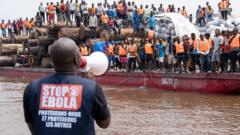

Freetown, Sierra Leone — In a sobering development echoing the haunting echoes of past public health emergencies on the African continent, authorities in the Democratic Republic of Congo have ordered a commercial river vessel into strict quarantine following a localized outbreak of the Ebola virus that has already claimed five lives. The decisive intervention, announced by the nation's health ministry, highlights the persistent, lurking threat of viral hemorrhagic fevers along the vital waterways of Central Africa, while simultaneously testing the resilience, preparedness, and logistical ingenuity of regional and international epidemiological response networks.
The quarantine order, which blankets the vessel and its entire complement of passengers and crew, underscores the precarious intersection of geography, commerce, and public health in the Congo Basin. Rivers in the Democratic Republic of Congo function not merely as bodies of water, but as the foundational arterial highways of the nation. In a country roughly the size of Western Europe where paved roads are sparse and infrastructure remains heavily compromised by decades of conflict, historical neglect, and economic underdevelopment, these aquatic routes are the primary conduits for human mobility, trade, and social cohesion. Consequently, when a pathogen as lethal as the Ebola virus infiltrates a river vessel, the potential for rapid, uncontrolled geographic dispersion increases exponentially, transforming a localized medical crisis into a potential cross-provincial or even international emergency.
According to official statements released by the Ministry of Health, the grim sequence of events began when several individuals on board the vessel manifested classic symptoms of Ebola virus disease, including sudden high fever, severe weakness, muscle pain, headaches, and sore throat, rapidly progressing in some cases to internal and external bleeding, vomiting, and multi-organ failure. Before the vessel could be intercepted and isolated by specialized health teams, five individuals succumbed to the infection. The speed with which the virus advanced within the confined ecosystem of the boat has alarmed public health officials, who note that close quarters, shared facilities, and limited sanitation infrastructure aboard many commercial river craft create an optimal environment for viral transmission through direct contact with bodily fluids.
The Logistical Nightmare of Riverine Quarantines
Enforcing a quarantine on a moving or newly docked vessel in the remote stretches of the Congo river system is an extraordinary logistical undertaking. Unlike fixed-site treatment units or urban quarantine zones, a waterborne containment vessel presents unique operational hurdles for medical personnel. Epidemiologists and infectious disease specialists deployed to the scene are tasked with securing the perimeter, establishing safe donning and doffing zones for personal protective equipment, and conducting meticulous, individual health screenings for every soul on board.
Every single passenger and crew member is currently undergoing rigorous, repeated symptom monitoring and thermal scanning. Those exhibiting even the mildest signs of fever or malaise are immediately separated from the general population on the boat, placed into makeshift isolation holds, and prepared for transfer to dedicated Ebola Treatment Centers (ETCs). Meanwhile, individuals who remain asymptomatic are slated for a mandatory monitoring period that aligns with the virus's maximum twenty-one-day incubation window. This requires a massive supply chain of clean water, non-perishable food, personal hygiene products, and medical supplies to be continuously delivered to the quarantined vessel, ensuring that those confined do not attempt to breach the perimeter out of desperation or hunger.
Furthermore, contact tracing—the bedrock of any successful epidemic response—becomes exponentially more complex in a riverine context. Passengers who may have disembarked at intermediate ports of call prior to the imposition of the quarantine must be tracked down across vast, densely forested jurisdictions. Local health bureaus are mobilizing community health workers, traditional leaders, and local law enforcement to identify any individuals who left the vessel at previous stops, urging them to report for immediate medical evaluation. The success of this sprawling containment operation will ultimately dictate whether this incident remains an isolated flare-up or metastasizes into a broader regional epidemic.
Historical Context: The Democratic Republic of Congo and the Ebola Burden
To fully comprehend the gravity of the current situation on the Congolese river vessel, one must view it through the historical lens of the Democratic Republic of Congo's long, agonizing history with the Ebola virus. It was, after all, along the banks of the Ebola River in the northern part of the country that the virus was first identified in 1976. Since that initial discovery, the nation has borne a disproportionate share of the global burden of the disease, experiencing multiple sporadic outbreaks driven by the virus's natural animal reservoirs, most notably fruit bats.
In recent decades, however, the frequency and complexity of these outbreaks have seemed to accelerate. The catastrophic West African Ebola epidemic of 2014 to 2016 fundamentally altered the global perception of the disease, but the DRC itself has weathered successive flare-ups in provinces such as Equateur, North Kivu, Ituri, and South Kivu. The massive North Kivu and Ituri outbreak, which lasted from 2018 to 2020, stands as the second-largest Ebola epidemic in recorded history. That crisis was uniquely complicated by active armed conflict, deep-seated community mistrust of state institutions and foreign medical workers, and attacks on treatment centers.
Outbreaks in the equatorial river regions, while historically somewhat less complex in terms of armed insurgency than the eastern provinces, present their own distinct vulnerabilities. The reliance on river commerce means that infections can travel hundreds of kilometers in a matter of days, bypassing traditional provincial checkpoints and landing in densely populated urban centers or crossing porous international borders into neighboring nations such as the Republic of Congo or the Central African Republic. The hard-won lessons from past outbreaks—emphasizing community engagement, early intervention, decentralized treatment, and the deployment of advanced medical countermeasures—are now being severely tested on the deck of this quarantined riverboat.
The Efficacy of Modern Medical Countermeasures
Fortunately, while the specter of Ebola remains deeply terrifying, the medical community enters this crisis armed with scientific tools that were unavailable during earlier decades of outbreak response. The landscape of Ebola treatment and prevention has undergone a revolutionary transformation, shifting from a paradigm of purely supportive care—where survival depended almost entirely on intravenous rehydration and managing symptoms—to an era of targeted therapeutics and highly effective prophylactic vaccines.
During recent outbreaks in the DRC, notably those managed under the guidance of the World Health Organization and the nation's National Institute for Biomedical Research, two primary monoclonal antibody treatments—specifically REGN-EB3 (Inmazeb) and mAb114 (Ebanga)—have demonstrated staggering efficacy. When administered early in the course of the infection, these advanced therapeutics neutralize the virus and dramatically increase survival rates, turning what was once considered an almost universally fatal diagnosis into a highly treatable condition for many patients.
Simultaneously, the deployment of the rVSV-ZEBOV-GP vaccine (marketed as Ervebo) has revolutionized containment strategies through the implementation of "ring vaccination." By vaccinating the immediate contacts of confirmed cases, as well as the contacts of those contacts—along with frontline healthcare workers and support personnel—epidemiologists can construct an immunological firebreak around the virus, halting its transmission chain before it can breach the broader community. Public health officials involved in the current riverboat quarantine are moving swiftly to deploy vaccine stockpiles to the site, aiming to inoculate all passengers, crew, and frontline responders who may have been exposed.
Socio-Economic and Political Implications
Beyond the immediate medical and humanitarian concerns, an Ebola outbreak of this nature carries profound socio-economic and political reverberations for the Democratic Republic of Congo. Economically, river transport is the lifeblood of internal commerce. Any prolonged disruption, quarantine, or generalized fear surrounding river travel immediately chokes the flow of agricultural produce, manufactured goods, and basic necessities to remote riverine communities. Small-scale traders, fishermen, and transport operators face devastating financial losses when vessels are immobilized, compounding the already severe economic hardships faced by millions of Congolese citizens living in extreme poverty.
Moreover, public health emergencies in the DRC invariably intersect with political sensitivities. Trust between local populations and central government authorities—as well as international humanitarian agencies—is frequently fragile. Decades of institutional instability, corruption, and the legacy of colonial exploitation have left many communities deeply skeptical of official pronouncements. When sweeping measures such as quarantines, forced isolation, or safe and dignified burials are implemented, they can sometimes trigger resistance or panic if not communicated with profound cultural sensitivity and transparency.
In past outbreaks, rumors and misinformation spread rapidly via social media and word-of-mouth, occasionally leading to violent incidents directed at medical workers or health facilities. Recognizing this historical vulnerability, contemporary response frameworks place a heavy emphasis on community-led risk communication. Engaging local elders, youth leaders, and traditional healers from the outset is no longer viewed as a supplementary public relations exercise, but as an indispensable pillar of operational success. Ensuring that the passengers on the quarantined vessel and the communities along the river banks understand the rationale behind the measures is just as critical as administering therapeutics or vaccines.
Regional and Global Security Perspectives
From a broader geopolitical and global security standpoint, any outbreak of Ebola in Central Africa commands the immediate attention of the international community. Pathogens recognize no borders, and in an era of unprecedented global mobility, a localized outbreak in a remote river basin possesses the theoretical capacity to seed international transmission events if containment protocols fail.
International bodies, including the World Health Organization, the Africa Centres for Disease Control and Prevention (Africa CDC), and bilateral partners, maintain continuous surveillance architectures designed to detect and respond to such threats in real-time. The integration of regional health networks allows for rapid information sharing, cross-border coordination of surveillance protocols, and the immediate mobilization of technical assistance and financial resources to support national authorities.
However, experts frequently warn that international response mechanisms can sometimes suffer from donor fatigue or bureaucratic inertia, particularly when the world's attention is fractured by multiple concurrent geopolitical crises, conflicts, and global health challenges. The resilience demonstrated by the DRC's own domestic public health infrastructure—forged in the crucible of repeated outbreaks—often serves as the primary bulwark against widespread disaster. The country's cadre of epidemiologists, laboratory technicians, and community engagement specialists are among the most experienced in the world when it comes to managing viral hemorrhagic fevers.
Expert Analyses and Future Projections
As the current situation unfolds on the quarantined Congolese river vessel, infectious disease experts and epidemiologists are offering cautious assessments regarding the trajectory of the event. Speaking anonymously due to the sensitivity of ongoing field operations, several senior public health consultants noted that while five deaths represent a deeply tragic and alarming start, the rapid imposition of the quarantine may have successfully cut off the virus's primary avenue of regional dissemination.
"The critical variable in any Ebola event is speed," noted one veteran epidemiologist with extensive experience in Central African outbreak responses. "When a floating vessel becomes a localized cluster, containing that vessel before it docks at a major urban port is the single most effective intervention you can execute. If the health ministry has indeed secured all passengers and initiated strict monitoring, isolation, and ring vaccination immediately, the likelihood of containing this cluster is reasonably high. However, we must remain vigilant regarding potential secondary chains of infection that may have already occurred at previous stops along the route before the quarantine order was issued."
Looking toward the future, public health authorities emphasize that incidents like this riverboat quarantine are stark reminders of the persistent vulnerability posed by natural zoonotic reservoirs. Because the Ebola virus circulates permanently among animal populations in the forested regions of Central Africa, eradication in the traditional sense remains biologically impossible with current technology. Instead, the ultimate strategic objective must be the strengthening of national health security systems—enhancing early warning surveillance in remote markets and transport hubs, expanding decentralized diagnostic capacities, ensuring robust supply chains for therapeutics and vaccines, and fostering enduring trust between communities and healthcare providers.
As the sun sets over the broad, murky waters of the Congo River, the quarantined vessel remains under heavy guard—a solitary floating microcosm of a timeless struggle between human ingenuity and ancient pathology. The eyes of the nation, and indeed the global public health community, are fixed firmly upon its deck. The coming days and weeks will test the mettle of the health ministry's response teams, the efficacy of modern medical countermeasures, and the resilience of a nation that has time and again stared down the most lethal viral threats known to humanity and lived to tell the tale.