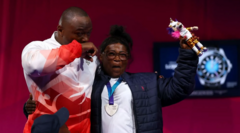

The journey from the harrowing uncertainty of displacement to the luminous, triumphant glare of an international podium represents one of the most profound narratives in modern athletics. For Cyrille Tchatchet II, securing a silver medal at the Commonwealth Games was not merely an athletic milestone; it was the physical manifestation of a near-impossible odyssey, a visceral reclamation of dignity, and the completion of a remarkable full-circle transformation that bridges the abyss between survival and elite sporting achievement.
Standing on the podium representing England, draped in the colors of his adopted home, Tchatchet encapsulated the very essence of human resilience. Yet, behind the gleaming silver hardware and the celebratory applause of thousands lies a harrowing history defined by flight, destitution, mental health struggles, and the bureaucratic labyrinths of the global asylum system. His victory has sent ripples far beyond the confines of the weightlifting arena, sparking intense conversations across the international community regarding the untapped potential, rights, and societal contributions of refugees worldwide.
From Displacement to the Platform: The Genesis of an Odyssey
The foundational chapters of Tchatchet’s life were written thousands of miles away from the training halls of England, in the Central African nation of Cameroon. It was there that he first discovered the sport of weightlifting, recognizing in the disciplined, explosive biomechanics of the discipline an outlet for his physical prowess and mental focus. He developed rapidly within the sport, displaying the raw talent and unyielding work ethic required to compete on the international stage.
However, the trajectory of his athletic career was abruptly severed by geopolitical turmoil and personal danger. Competing internationally in Glasgow during a previous major multi-sport event, Tchatchet faced circumstances that rendered a safe return to his homeland impossible. Fearing for his safety, he made the agonizing decision to leave the team delegation, effectively cutting ties with his previous life and plunging headfirst into the terrifying unknown of seeking asylum in a foreign country.
What followed was a period of profound destitution. Stranded in a new country with minimal financial resources, language barriers, and an uncertain legal status, Tchatchet experienced the crushing weight of homelessness. For a time, the streets of Brighton offered little shelter from the biting cold or the psychological torment of his sudden disenfranchisement. The contrast between the elite athlete who had competed under bright arena lights and the destitute man sleeping rough could not have been starker. During these darkest hours, the barbel that had once defined his identity felt light years away, replaced by the daily, grinding struggle for basic survival.
The Psychological Crucible: Navigating Mental Health in Exile
The psychological toll of forced displacement is a subject frequently studied by sociologists, psychologists, and public health experts, yet it remains deeply misunderstood by the general public. When an elite athlete is stripped of their community, their routine, and their legal identity, the trauma is compounded. For Tchatchet, the transition from being a celebrated competitor to an anonymous asylum seeker triggered acute psychological distress.
Mental health professionals who have analyzed refugee integration frequently emphasize the concept of ambiguous loss—the grief that comes with a sudden, unresolved separation from one's homeland, culture, and social safety net. In Tchatchet’s case, this was compounded by the intense pressure of navigating a notoriously complex and frequently hostile immigration system. The constant dread of deportation, coupled with the daily indignities of poverty, pushed him to the absolute brink.
It was during this period of acute vulnerability that Tchatchet demonstrated perhaps his greatest act of courage: he sought help. Recognizing that his mental health was deteriorating rapidly, he engaged with local support networks, mental health charities, and medical professionals in the United Kingdom. This crucial step not only saved his life but also provided the foundational stability required to slowly rebuild his physical conditioning. His willingness to speak openly about his struggles with depression and anxiety has since positioned him as an unexpected mental health advocate, breaking down long-standing stigmas surrounding psychological vulnerability, particularly within the hyper-masculine environments of strength sports.
Rebuilding the Athlete: The Convergence of Sport and Mental Health Care
Recovery, both psychological and physical, is rarely a linear process. For Tchatchet, the rediscovery of weightlifting was initially less about chasing medals and more about reclaiming agency over his own body. In the controlled environment of the gym, gravity is an honest adversary—unlike the capricious and often opaque rules of immigration bureaucracy, the barbell responds predictably to calculated force, proper technique, and relentless dedication.
As his legal status slowly stabilized—culminating in the granting of refugee status and, eventually, British citizenship—Tchatchet was able to channel his energies more systematically. He balanced grueling training schedules with academic pursuits, ultimately pursuing a qualification in mental health nursing. This dual commitment to physical excellence and the care of others speaks volumes about his character. While many athletes maintain a singular, inward-looking focus, Tchatchet’s lived experience compelled him to look outward, using his professional ambitions to give back to the very healthcare system that had supported him during his darkest hours.
Coaches and training partners who worked with him during this resurgence note his extraordinary threshold for pain and discomfort. But they are quick to point out that this resilience was forged not just in the gym, but on the streets and in the counseling rooms. The mental fortitude required to step onto an international lifting platform after experiencing homelessness and near-destitution is difficult to quantify. It requires a distinct psychological armor—one built on self-compassion, radical acceptance, and an unshakeable belief in one's own future.
The Commonwealth Games Triumph: Symbolism and Substance
When Tchatchet stepped onto the platform at the Commonwealth Games, representing England, the atmosphere in the arena crackled with a distinct intensity. This was not merely a display of athletic prowess; it was the symbolic culmination of a decade of struggle, perseverance, and integration. Lifting in the colors of his adopted nation, he engaged in a fierce tactical battle with some of the finest weightlifters in the Commonwealth.
With every successful lift, the crowd recognized the magnitude of the moment. The silver medal he ultimately secured was a testament to his technical mastery, tactical acumen, and physical conditioning. Yet, the emotional resonance of the achievement far outweighed the metal itself. To stand on the podium, watching the flag of his adopted home rise while knowing the immense distance he had traveled—both geographically and existentially—created a moment of collective catharsis for everyone present.
In post-competition interviews, Tchatchet articulated a profound sense of gratitude, expressing that he felt "very proud and honoured" to represent England. These were not mere platitudes; they reflected a genuine, hard-won sense of belonging. In a world where national identity is frequently weaponized to exclude and divide, Tchatchet’s victory offered a powerful counter-narrative—one that frames migration not as a threat, but as an enrichment of the cultural and athletic fabric of society.
Socio-Political Implications: Sport as a Vehicle for Refugee Integration
The narrative surrounding Cyrille Tchatchet II intersects directly with critical contemporary debates regarding immigration, refugee rights, and social integration. Across the globe, political discourse is frequently dominated by restrictionist policies and a framing of displaced populations as passive burdens on state resources. Athletes like Tchatchet dismantle this reductive stereotype with undeniable empirical reality.
Sports organizations, including the International Olympic Committee and various Commonwealth sporting federations, have increasingly recognized the importance of providing pathways for displaced athletes. Initiatives such as the Refugee Olympic Team have provided platforms for elite competitors who have been forced to flee their homelands. However, Tchatchet’s path—transitioning from an asylum seeker to representing his host nation—highlights a different, equally vital model of integration: full assimilation into the national team structure through citizenship and residency.
Sociologists specializing in migration studies point out that sport serves as one of the most effective vehicles for social cohesion. On the athletic field, meritocracy, shared effort, and collective goals frequently dissolve systemic prejudices. When a crowd cheers for an athlete like Tchatchet, national identity is momentarily decoupled from ancestral lineage and anchored instead in shared values, mutual effort, and civic participation. His success challenges host communities to re-evaluate their perceptions of refugees, shifting the focus from vulnerability to agency, and from dependency to contribution.
Economic and Institutional Perspectives on Refugee Athletes
Beyond the socio-cultural impacts, the trajectory of athletes who arrive as refugees carries significant economic and institutional lessons. High-performance sport is a multi-billion-dollar enterprise that relies on talent identification, institutional support, and sustained investment. Historically, sports federations have struggled to incorporate populations outside the traditional club and collegiate pipelines.
The integration of refugees into elite sports systems requires institutional flexibility, legal advocacy, and targeted financial support. Organizations that assist refugee athletes often operate on shoestring budgets, relying heavily on volunteer networks, charitable donations, and grassroots activism. Tchatchet’s success serves as a compelling case study for sports governing bodies to formalize these pathways. By investing in the athletic potential of displaced persons, nations not only unearth world-class talent but also foster social cohesion that benefits the broader community.
Furthermore, Tchatchet’s dual life as an elite athlete and a trained mental health professional underscores the broader economic argument for refugee integration: displaced individuals are not one-dimensional subjects defined solely by their legal status. They possess multifaceted skill sets, professional ambitions, and intellectual capacities that, when supported by stable housing, legal security, and educational access, generate profound dividends for the host economy.
Global Perspectives and Historical Parallels
The phenomenon of the refugee athlete is as old as modern sport itself, yet its visibility has evolved dramatically in the 21st century. From historic Olympians who fled conflict in Europe during the mid-20th century to contemporary competitors arriving from zones of conflict in the Middle East, Africa, and Eastern Europe, sport has consistently provided a sanctuary for those displaced by geopolitics.
However, the contemporary global landscape—characterized by mass displacement due to climate change, protracted conflicts, and economic instability—demands a more systemic institutional response. Analysts tracking global migration trends note that stories like Tchatchet’s are often statistical outliers precisely because the systemic barriers to participation remain exceptionally high. For every refugee who manages to navigate the dual challenges of legal integration and elite athletic training, countless others are lost to poverty, psychological distress, and systemic exclusion.
Therefore, sports journalists, policy makers, and human rights advocates emphasize that Tchatchet’s silver medal should not be viewed merely as a feel-good human interest story, but as a systemic challenge to sporting institutions. It asks a fundamental question: How many potential champions, scientists, artists, and leaders are currently languishing in immigration detention centers, temporary camps, or precarious legal limbos because society fails to provide them with the basic tools of stability and dignity?
The Future Horizon: Legacy and Continuing Advocacy
As Cyrille Tchatchet II looks toward the future, his legacy is already firmly secured, yet his ambitions remain expansive. Having proven his mettle on the international stage, he continues to train with an eye toward future competitions, pushing the boundaries of his physical capabilities while maintaining his professional commitments in healthcare.
His dual identity as both a high-performance athlete and a mental health advocate places him in a unique leadership position. In an era where athletes are increasingly expected to use their platforms for social good, Tchatchet does not need to manufacture a cause; his entire life is an embodiment of resilience, advocacy, and human dignity. Whether speaking to young athletes, mentoring newly arrived asylum seekers, or working in clinical settings, his message remains consistently grounded in the power of perseverance, the necessity of mental health support, and the transformative potential of inclusion.
The full circle of his journey—from a frightened young man sleeping rough on the streets of a foreign city to a proud medalist standing under the bright lights of the Commonwealth Games—stands as a monumental testament to the indomitable human spirit. It reminds the global community that beneath the statistics of global migration are individual human beings capable of extraordinary greatness, if only given the chance to lift the weight of adversity and step into the light.