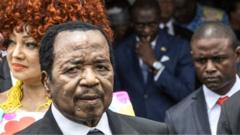

YAOUNDÉ — In a high-stakes move that has reverberated across the corridors of power in Central Africa, Cameroon’s long-standing leadership has enacted a sweeping and decisive overhaul of the nation's military high command. This strategic restructuring arrives at a time of acute political sensitivity, unfolding directly against the backdrop of an extended two-month absence of the world's oldest sitting head of state from the public sphere. As speculation mounts and anxiety ripples through both domestic civil society and international diplomatic circles regarding the president's true health and administrative capacity, the recent military decrees underscore a desperate race to consolidate control, deter potential dissent, and manage the chaotic mechanics of an unspoken succession struggle.
The administrative decrees, signed quietly and broadcast through state-controlled media channels, have reshaped key divisions within the Cameroonian Armed Forces. While routine military rotations are common in sovereign states, the timing, scale, and specific structural nature of this particular reshuffle have marked it out as an extraordinary political intervention. Observers within the capital city of Yaoundé, alongside international analysts tracking the volatile region, view the move not merely as a tactical defense adjustment, but as a calculated maneuver by an inner circle fiercely protective of a fading political monopoly. By repositioning loyalists into critical operational commands, the presidency aims to fortify its position against a backdrop of mounting uncertainty, public restlessness, and simmering internal factionalism.
For weeks, the physical absence of the nation's chief executive has dominated regional conversations. Rumors, unverified reports, and intense digital speculation regarding the president's medical status have circulated widely, fueled by his prolonged stay in Europe—ostensibly described by official spokespersons as a "short private working visit." However, as weeks stretched into months without a verified public appearance, televised address, or tangible proof of life beyond carefully curated and frequently contested photographs released by state communications teams, the official narrative began to fray. The gap between official denials and public anxiety has created a vacuum of authority, a dangerous state of affairs in a strategically vital nation that anchors the Economic and Monetary Community of Central Africa.
To fully understand the gravity of the current military reshuffle, one must examine the unique political architecture of Cameroon, a nation often described as a microcosm of Africa's broader post-colonial challenges. Having held power for over four decades, the current administration has systematically woven its survival into the fabric of the state's institutional machinery. Over successive decades, governance has transitioned from a broad-based nationalist project into a tightly centralized autocracy reliant on a delicate balance of ethnic alliances, political patronage, and security force loyalty. The military, therefore, is not merely an instrument of national defense against external threats or asymmetric insurgencies; it is the ultimate arbiter of political survival within the domestic sphere.
Historically, the Cameroonian military has experienced various iterations of structural reform, yet its core mandate of regime preservation has remained absolute. In the face of multifaceted security crises—ranging from the protracted Anglophone crisis in the Northwest and Southwest regions to the persistent, deadly incursions of Boko Haram in the Far North—the armed forces have operated under immense strain. Commanders on the ground have often found themselves stretched thin, battling both well-armed jihadist elements and separatist militias while navigating the labyrinthine political loyalties demanded by the central government in Yaoundé. By altering the top brass during a moment of profound executive paralysis, the inner circle is signaling that loyalty to the current political order supersedes operational efficiency on the battlefield.
The mechanics of the recent military decrees reveal a meticulous focus on intelligence, presidential security, and strategic territorial commands. Key posts within the elite Rapid Intervention Battalion, known by its French acronym BIR, and the presidential guard have been subjected to careful scrutiny. These elite units represent the physical wall standing between the ruling elite and any potential coup d'état, popular uprising, or palace rebellion. In political environments where aging autocrats cling to power without a clear constitutional or consensual successor, the military becomes the primary theater for succession politics. Generals and senior colonels suddenly find themselves courted by rival factions within the ruling party, each seeking to secure armed backing for the day the ultimate vacancy occurs.
The official response to the escalating rumors regarding the president's health has been characterized by defensive stonewalling and aggressive legal warnings. Government spokespersons have repeatedly gone on the offensive, labeling inquiries and independent reporting as malicious disinformation manufactured by domestic malcontents and hostile foreign actors seeking to destabilize the nation. State media broadcasts have featured prominent ministers and party loyalists rallying around the flag, demanding absolute national unity and threatening legal consequences for anyone daring to publicly discuss the physical capabilities of the head of state. Yet, these heavy-handed information controls have achieved the opposite of their intended effect, only deepening public skepticism and accelerating the rumor mill across digital platforms.
This information vacuum exposes a profound institutional vulnerability. When a government invests its entire political identity in a single, immortalized figure rather than robust, independent democratic institutions, any disruption to that figure's routine triggers systemic panic. The state's communication strategy—relying on staged photographs and defiant denials rather than transparent, verifiable engagement—reflects a deep-seated fear of vulnerability. It demonstrates that the ruling elite is acutely aware of the fragility of the status quo. They recognize that if the public perceives the leadership as truly incapacitated, the psychological barrier holding back mass mobilization and elite defection could instantly collapse.
Economically, the prolonged political uncertainty poses severe risks to Cameroon's stability and development trajectory. Investors, both domestic and foreign, thrive on predictability and the rule of law. The current climate of ambiguity regarding the nation's political future has caused significant hesitation in foreign direct investment. Major infrastructure projects face bureaucratic paralysis as mid-level bureaucrats await direction from superiors who are themselves paralyzed by succession anxiety. Furthermore, international financial institutions and development partners monitor the situation with growing apprehension. Economic reforms require political capital and decisive leadership—two commodities that are currently in critically short supply in Yaoundé.
Regionally, Cameroon occupies a pivotal geopolitical position. Bordering Nigeria, Chad, the Central African Republic, the Republic of the Congo, Equatorial Guinea, and Gabon, its stability is vital for the entire Central and West African security architecture. A destabilized Cameroon would not only trigger a massive humanitarian crisis characterized by refugee flows into neighboring territories, but it would also create a strategic vacuum that extremist networks and opportunistic regional players could exploit. Central African neighbors, many of whom face their own internal governance challenges, are watching the developments in Yaoundé with nervous anticipation, fully aware that political tremors in Cameroon send shockwaves across the entire sub-region.
International reactions have been marked by diplomatic caution and quiet behind-the-scenes lobbying. Western capitals and traditional bilateral partners, mindful of their strategic and counter-terrorism partnerships with Yaoundé, have largely avoided overly confrontational public statements. However, diplomatic cables are undoubtedly buzzing with contingency plans. Foreign ministries are carefully assessing the readiness of their diplomatic missions to handle potential emergency scenarios, evacuation protocols, and rapid political transitions. The international community faces a delicate balancing act: maintaining necessary security cooperation while signaling that a dynastic succession or unconstitutional power grab will face severe diplomatic and economic repercussions.
Civil society organizations and political opposition parties within Cameroon have seized upon the current crisis to demand greater transparency and constitutional adherence. Opposition leaders have repeatedly pointed to Article 35 of the constitution, which outlines the mechanisms for interim governance in the event of a permanent vacancy of the presidency. They argue that the ongoing concealment of the president's true medical condition is a betrayal of the public trust and an insult to the national constitution. However, opposition parties remain fractured, historically struggling to present a unified front against a deeply entrenched ruling apparatus that controls the electoral commission, the judiciary, and the security forces.
The dynamics of succession within authoritarian and semi-authoritarian regimes are notoriously treacherous, often described by political scientists as a complex game of musical chairs played on a shifting floor. In Cameroon, the succession battle is not merely a contest between the ruling party and the opposition; it is an intense, cutthroat intra-elite struggle. Factions within the ruling party, intelligence services, economic oligarchs, and regional power-brokers are actively positioning themselves to seize control of the state apparatus when the inevitable transition occurs. The recent military reshuffle is widely interpreted as a pre-emptive strike by one faction within the presidential circle to sideline rival contenders and secure control over the instruments of coercion before a crisis forces their hand.
As the weeks continue to pass without a definitive, unscripted public appearance by the head of state, the psychological pressure on the regime mounts. Every day that the president remains absent, the credibility of the official narrative diminishes further. Rumors take on the weight of established facts in the public consciousness, and the informal networks of power become increasingly frantic. The military high command, now reorganized with handpicked loyalists, finds itself thrust into an uncomfortable spotlight. They are expected to act as the ultimate guarantor of order, yet they are acutely aware that enforcing political obedience in a deeply disillusioned society is a precarious and unsustainable mission.
Looking ahead, political analysts outline several potential trajectories for the unfolding crisis in Cameroon. The most immediate scenario involves the continuation of the current strategy: the inner circle maintains the illusion of normalcy, managing governance through proxy while orchestrating micro-adjustments in security and administration until a managed transition can be arranged. However, this path is fraught with hazard, as any sudden deterioration in the president's health or an unexpected leak from within the medical or administrative team could shatter the fragile façade instantly.
A second, more volatile scenario involves an overt split within the ruling elite. If rival factions within the security establishment and the ruling party conclude that the current power-sharing arrangement no longer serves their interests, internal friction could spill over into open confrontation. Such a scenario would test the loyalty of the newly reshuffled military units, raising the specter of factional infighting within the armed forces—a development that would spell catastrophic consequences for national stability.
A third, more hopeful yet increasingly unlikely scenario involves a sudden, transparent acknowledgment of reality by the state apparatus, leading to a constitutional transition managed in accordance with legal norms and inclusive dialogue. While this would offer the best chance for long-term national healing and economic recovery, the historical behavior of entrenched authoritarian regimes makes such a peaceful, institutional handover a distant prospect.
Ultimately, the developments in Yaoundé serve as a stark reminder of the inherent structural vulnerabilities of personalized rule. When a nation's destiny is inextricably bound to the biological longevity of a single individual, governance ceases to be a dynamic, responsive public service and devolves into a high-stakes endurance test. The world's oldest president may still hold the formal titles of power, but the frantic reshuffling of the army and the desperate denials from state media reveal a regime acutely conscious of the sands slipping through its fingers. As Cameroon stands at this historic and perilous crossroads, the actions taken by its military and political elites in the coming days and weeks will define the trajectory of the nation for a generation to come.