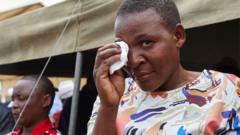


FREETOWN — As the global community evaluates the persistent drivers of instability across fragile states, a comprehensive analysis of conflict dynamics reveals a deeply entrenched, systemic crisis: the pervasive use of sexual violence as an instrument of war and intimidation. Drawing from extensive global monitoring data updated through July 2026, international human rights organizations and humanitarian networks have released sobering findings detailing the lived realities of survivors across multiple continents, including the Central African Republic, the Democratic Republic of the Congo, Ethiopia, Sudan, South Sudan, Myanmar, India, Cuba, Mexico, and Sierra Leone. This reporting sheds light not only on the harrowing accounts of those who have broken their silence, but also on the staggering institutional and structural barriers that keep the vast majority of such crimes shrouded in perpetual impunity.
For the Sierra Leonean public, and for observers across the wider West African subregion, these revelations carry a profound historical resonance. Having navigated the painful legacy of civil conflict where gender-based violence was deployed systematically to terrorize communities, the nation understands intimately the long road to healing, justice, and societal reconstruction. The global data compiled in mid-2026 serves as a stark reminder that while normative frameworks have evolved at the international level, the ground-level protection of vulnerable populations—particularly women and girls residing in remote, conflict-ridden peripheries—remains profoundly inadequate.
The Anatomy of Silence: Understanding the Under-Reporting Crisis
At the core of the global crisis in reporting sexual violence and abuse in conflict is a staggering statistical reality: the vast majority of incidents are never formally documented. This silence is not passive; it is actively manufactured and sustained by a matrix of fear, social stigma, structural neglect, and the active destruction of civil infrastructure in war zones. When state bodies, rebel factions, or unrecognized armed groups utilize sexual violence as a tactical weapon of war, the objective extends far beyond immediate physical harm. The goal is the systematic subjugation of communities, the destruction of social cohesion, and the enforcement of enduring psychological trauma.
Survivors who choose to speak out often do so at immense personal risk. In many traditional and transition societies, the social stigma attached to sexual violence falls disproportionately upon the victim rather than the perpetrator. This can lead to ostracization, familial rejection, and economic destitution. Furthermore, in active conflict zones, the institutional mechanisms designed to receive complaints, provide medical triage, and dispense justice are frequently the first casualties of war. Police stations are burned, judicial courts are suspended, and medical personnel are targeted or forced to flee. Consequently, the fragmented accounts that manage to pierce the veil of global indifference represent merely the tip of a massive, submerged iceberg of suffering.
Central African Republic: Livelihoods Under Siege in Ouham-Fafa and Vakaga
The July 2026 monitoring data from the Central African Republic provides a harrowing illustration of how structural insecurity intersects with the daily economic survival strategies of women and girls. In the prefectures of Ouham-Fafa and Vakaga, recent incidents highlight a grim reality: routine livelihood activities—such as gathering firewood, fetching water, or traveling to local agrarian markets—have been transformed into high-risk endeavors.
In these remote and isolated rural communities, state authority is frequently nominal or entirely absent, leaving populations at the mercy of a shifting landscape of armed actors. The July assessments specifically implicated unidentified armed men and elements associated with lingering factions such as the Lord's Resistance Army (LRA). These groups operate with virtual impunity across porous borders and dense forested terrain, exploiting the logistical nightmares humanitarian agencies face when trying to deliver aid or protection services.
The implications of these dynamics are deeply alarming. When women are targeted while engaging in essential subsistence activities, the immediate consequence is food insecurity and economic collapse at the household level. Fear of attack forces communities to abandon agricultural plots, leading to diminished crop yields and deepening dependency on erratic humanitarian assistance. Compounding this crisis is the profound lack of specialized medical and psychosocial services in these regions. Survivors in Ouham-Fafa and Vakaga face daunting geographical barriers just to reach basic healthcare facilities, let alone trauma counseling or post-exposure prophylaxis for sexually transmitted infections and unwanted pregnancies.
Democratic Republic of the Congo: Transport Corridors and Dual Threats
Turning to the Democratic Republic of the Congo, the July 2026 reports from Kwilu and South Kivu provinces lay bare a complex landscape of vulnerability. The DRC has long struggled with the multi-layered dimensions of conflict, where state security forces and a myriad of non-state armed groups frequently operate in close proximity to civilian populations.
The recent incidents documented in Kwilu and South Kivu underscore a deeply troubling trend: sexual violence is not merely a byproduct of chaos, but a persistent hazard along key transport routes and economic arteries. As merchants, farmers, and travelers move goods between rural production centers and urban markets, they pass through checkpoints and territories controlled by armed elements. Women traders, who form the backbone of local micro-economies, are acutely vulnerable to extortion, harassment, and sexual assault during these transit phases.
Crucially, the involvement of both unidentified armed men and, disturbingly, elements within state security forces highlights a profound crisis of accountability. When the very institutions tasked with maintaining public order and protecting citizens are implicated in grave human rights violations, public trust collapses entirely. This dynamic creates a chilling effect on reporting. Survivors attacked by state actors face compounded fears of retaliation, arbitrary detention, and institutional cover-ups. The absence of robust internal vetting and independent judicial oversight within the security apparatus perpetuates a cycle of impunity that undermines broader peacebuilding and state-reform initiatives.
Global Echoes: A Cross-Continental Crisis
While Central Africa remains a prominent epicenter of documented conflict-related sexual violence, the July 2026 global overview emphasizes that this is a universal crisis transcending regional boundaries. From the protracted conflicts in Sudan and South Sudan—where humanitarian access is frequently weaponized and civilian populations face rampant displacement and abuse—to the volatile security landscapes in Ethiopia, Myanmar, and regions of India, the modus operandi of armed conflict consistently targets the bodily autonomy of women and girls.
In each of these contexts, unique socio-political factors exacerbate the vulnerability of populations. In Myanmar, ongoing civil strife following military consolidation has displaced hundreds of thousands, creating dense, unprotected populations highly susceptible to exploitation. In Sudan and South Sudan, localized ethnic tensions, coupled with the collapse of central governance structures, have unleashed waves of targeted violence where sexual assault is utilized systematically to humiliate rival communities and drive forced displacement.
Furthermore, the inclusion of countries like Cuba, Mexico, and Sierra Leone in broader global dialogues on gender-based violence and security reminds us that the continuum of violence extends beyond active battlefield zones. In nations grappling with organized crime cartels, structural socioeconomic inequalities, or post-conflict institutional fragility, the safety of women remains precarious. In Mexico, for instance, the pervasive influence of criminal syndicates creates an environment of pervasive fear where gender-based violence often goes unpunished due to institutional corruption and overburdened investigative systems. In Sierra Leone, while direct civil conflict has long since ceased, the enduring institutional scars demand constant vigilance, robust legal enforcement, and continuous community-level education to protect women and girls from domestic and structural abuse.
Socioeconomic and Political Implications of Unpunished Abuse
The systemic failure to address and prosecute conflict-related sexual violence carries profound economic and political consequences that ripple far beyond the immediate victims. Economically, the systematic targeting of women cripplingly disrupts agrarian productivity, cross-border trade, and local market ecosystems. Women are foundational to the informal and formal economies of developing nations; when they are displaced, traumatized, or forced to abandon their livelihoods, entire local economies stagnate.
Politically, pervasive sexual violence in conflict erodes the legitimacy of the state and undermines any credible pathway to sustainable peace. A government that cannot or will not protect its most vulnerable citizens from heinous abuses—let alone hold perpetrators within its own armed forces accountable—lacks the moral authority required for national reconciliation. Moreover, peace agreements that fail to incorporate robust accountability mechanisms for sexual violence invariably sow the seeds for future conflict. Impunity breeds contempt for the rule of law and signals to future combatants that bodily integrity is an acceptable collateral damage of war.
From an international security perspective, the normalization of sexual violence as a weapon of war represents a direct challenge to the rules-based international order. United Nations Security Council Resolution 1325 and its subsequent iterations explicitly recognize that sexual violence in conflict is a threat to international peace and security. Yet, the gap between normative declarations in New York or Geneva and the stark realities on the ground in places like Ouham-Fafa, South Kivu, or Darfur remains distressingly wide.
Expert Analyses and Policy Recommendations
Leading international humanitarian law experts and human rights advocates stress that addressing this crisis requires a paradigm shift in how the global community responds to conflict-related emergencies. Traditional humanitarian responses, which often prioritize food, shelter, and basic medical aid, must be expanded to integrate comprehensive, survivor-centric protection and justice services from the earliest stages of a crisis.
First, there must be a concerted effort to decentralize protection services, making them accessible to remote and rural communities where the risk of isolation is highest. Relying on survivors to travel long, perilous distances through conflict zones to report crimes or receive medical care is structurally untenable. Mobile clinics, community-based legal aid networks, and trusted local civil society organizations must be adequately funded and empowered to operate in high-risk areas.
Second, international and domestic judicial bodies must prioritize the prosecution of sexual violence charges. Too often, war crimes tribunals and national courts focus exclusively on high-level command responsibility for territorial conquest or mass killings, relegating sexual violence to a secondary or overlooked category of offenses. Specialized investigative units trained in handling sensitive evidence, protecting vulnerable witnesses, and interviewing trauma survivors without causing re-traumatization are essential for dismantling the wall of impunity.
Third, security sector reform (SSR) must become a non-negotiable prerequisite for international military assistance and peacebuilding support. State armed forces and police units operating in volatile regions must undergo rigorous vetting processes to remove individuals implicated in human rights abuses. Training on international humanitarian law, gender sensitivity, and the strict prohibition of sexual violence must be mandatory and continuously reinforced at all command levels.
The Moral Imperative of Amplifying Survivor Voices
Ultimately, the July 2026 global reports are more than statistical compendiums or academic risk analyses; they are testimonies to human resilience in the face of unimaginable adversity. The individuals who broke the silence—often at great personal peril—have performed a profound service to humanity by refusing to let their suffering be erased by the fog of war.
For the international media, policymakers, and civil society organizations, listening to these accounts must be coupled with concrete, sustained action. The normalization of violence against women in conflict is not an immutable law of nature; it is a man-made catastrophe that requires a coordinated, uncompromising human response. As nations across Africa, Asia, Latin America, and beyond grapple with overlapping crises of insecurity, the protection of women and girls must be elevated to the absolute center of the global peace and security agenda.
From the perspective of Sierra Leone—a nation that understands the arduous transition from the darkness of conflict to the light of institutional rebuilding—the global message is clear: true peace can never be achieved while half the population remains exposed to the silent terror of unpunished violence. The voices of survivors from the Central African Republic, the Democratic Republic of the Congo, and across the globe demand not merely our sympathy, but our unwavering commitment to justice, accountability, and systemic reform.