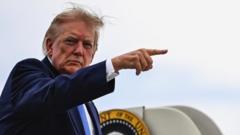

In a diplomatic development that underscores the evolving geopolitical dynamics of North Africa, a formal correspondence from King Mohammed VI of Morocco has verified the official dedication of a major transportation artery in honor of former United States President Donald Trump. This significant infrastructure project, strategically situated within the contested territory of Western Sahara, serves as a tangible physical manifestation of a complex diplomatic bargain struck years prior—a bargain that fundamentally reshaped Washington's stance on a decades-old territorial dispute and reoriented Morocco's international alliances.
The confirmation, communicated through official royal channels, solidifies a tribute that marries domestic infrastructure development with high-stakes foreign policy signaling. As geopolitical tensions simmer across the Maghreb and the Sahel, the highway—spanning vast desert landscapes and integrating the disputed region more deeply into the administrative and economic fabric of the Moroccan state—stands as a monument to a pivotal chapter in international diplomacy. For the Kingdom of Morocco, the road is far more than a marvel of civil engineering; it is a permanent geographical statement inscribed upon the earth, celebrating a historic diplomatic breakthrough that validated Rabat's sovereignty claims in the eyes of a global superpower.
Historical Background of the Western Sahara Dispute
To fully understand the weight of King Mohammed VI's tribute, one must examine the protracted history of Western Sahara, a territory often described as Africa's last unresolved colony. Spanning approximately 266,000 square kilometers of mineral-rich, arid land bordered by Morocco, Mauritania, and Algeria, the region has been a focal point of intense nationalist fervor and international legal debate since the withdrawal of Spanish colonial forces in the mid-1970s.
Following Spain's departure, Morocco asserted historical ties to the territory, while the Polisario Front, representing the indigenous Sahrawi population and backed heavily by neighboring Algeria, declared the establishment of the Sahrawi Arab Democratic Republic (SADR). This ideological and territorial collision led to a bitter, protracted guerrilla war that lasted until the United Nations brokered a ceasefire in 1991. The agreement established the UN Mission for the Referendum in Western Sahara (MINURSO), with the mandate to hold a self-determination vote that would allow the local population to choose between independence and integration with Morocco.
Decades have passed, however, and that referendum has never materialized. Disagreements over voter eligibility, political maneuvers by both parties, and shifting international priorities left the peace process in a state of permanent paralysis. In the interim, Morocco pursued a two-track strategy: consolidating administrative and physical control over roughly 80 percent of the territory—building massive infrastructure projects, fostering economic development, and encouraging Moroccan citizens to settle in the region—while maintaining a diplomatic offensive aimed at convincing the international community of its autonomy plan, which proposes wide-reaching regional governance under Moroccan sovereignty.
The Trump Administration Pivot: The Abraham Accords and Western Sahara
For decades, the official position of the United States regarding Western Sahara remained carefully calibrated. Washington consistently supported the UN-led peace process while avoiding explicit endorsement of either Moroccan sovereignty or Sahrawi independence. This strategic ambiguity shifted dramatically in the closing weeks of the Trump administration, producing a seismic diplomatic shockwave across North Africa.
In December 2020, the United States executed a historic policy reversal. Through a presidential proclamation, Washington formally recognized Moroccan sovereignty over the entirety of Western Sahara. This pivotal move was not made in isolation; it was the cornerstone of a grand diplomatic bargain that saw Morocco normalize diplomatic relations with Israel, joining the expanding framework of the Abraham Accords. In exchange for establishing formal ties with the Jewish state—an arrangement encompassing direct commercial flights, technological cooperation, and diplomatic exchanges—Rabat secured the ultimate diplomatic prize from Washington.
The recognition by the United States marked a monumental victory for Moroccan foreign policy. As a permanent member of the United Nations Security Council with veto power, Washington's endorsement provided unprecedented international legitimacy to Rabat's claims. It was within this climate of profound diplomatic realignment that plans for the highway infrastructure in Western Sahara were conceptualized and executed, designed not merely to facilitate regional commerce, but to permanently enshrine the partnership between the Moroccan monarchy and the American administration that altered the geopolitical calculus of the region.
Economic Implications and Regional Integration
Beyond the realm of high-level diplomacy and symbolic gestures, the newly named highway plays a vital, practical role in the economic integration of Western Sahara. Infrastructure development has long been the primary tool through which Rabat seeks to cement its administrative integration of the territory. Billions of dollars have been channeled into the region over the past two decades to construct deep-water ports, renewable energy installations, agricultural hubs, and advanced transportation networks.
The highway in question serves as a critical economic artery, stitching together remote desert settlements with major urban centers in northern Morocco and extending down toward the Mauritanian border. By facilitating the rapid and secure movement of goods, labor, and services, the project aims to transform Western Sahara into a bustling commercial gateway connecting North Africa to the broader sub-Saharan market. Fisheries, phosphate mining, and burgeoning agricultural projects in the region rely heavily on these modern transport corridors to reach international export markets.
Furthermore, economic analysts point out that these infrastructure investments are designed to demonstrate the tangible benefits of Moroccan administration to the local populace. By fostering job creation, improving living standards, and modernizing urban centers like Dakhla and Laayoune, Rabat hopes to neutralize separatist sentiments and present a compelling argument for the viability of its autonomy initiative. The association of this vital economic lifeline with the name of a former U.S. president underscores the administration's belief that international validation and economic modernization must go hand in hand.
Geopolitical Reactions: The Algerian Factor and the Maghreb Stalemate
Every action in the delicate ecosystem of North African geopolitics generates an immediate and often volatile reaction. The formal confirmation of the highway's naming—and the underlying U.S. recognition it commemorates—has been met with predictable fury in Algiers. Algeria, which views the Western Sahara conflict through the prism of anti-colonialism and national security, has consistently opposed any moves that legitimize Moroccan control over the territory.
The U.S. policy shift in 2020 served as a catalyst for a sharp deterioration in Algerian-Moroccan relations, culminating in Algiers severing diplomatic ties with Rabat in August 2021. The closure of borders, airspace restrictions, and a series of verbal and diplomatic salvos have brought regional cooperation within the Arab Maghreb Union to a complete standstill. From the perspective of Algiers, the formal dedication of infrastructure honoring a foreign leader who endorsed Morocco's territorial claims is viewed as an explicit provocation and a direct challenge to international law and United Nations resolutions.
International relations experts note that the Western Sahara dispute has effectively transformed the Maghreb into one of the most structurally fractured regions in the global economy. While Morocco builds its case on effective administration and strategic alliances with Western and Arab powers, Algeria continues its steadfast diplomatic and military backing of the Polisario Front, ensuring that the conflict remains a permanent fixture on the agenda of the United Nations Security Council.
The Global Perspective and International Law
The broader international community remains deeply divided over the status of Western Sahara, creating a complex patchwork of legal and diplomatic stances. While the United States remains the most prominent global power to recognize Moroccan sovereignty, other nations have adopted varied approaches. Several European countries, including Spain—the former colonial power—and Germany, have praised Morocco's autonomy plan as a serious and credible basis for resolving the conflict, stopping short, however, of full formal recognition of sovereignty.
At the same time, numerous African nations have opened consulates in the cities of Dakhla and Laayoune, signaling a growing wave of continental support for Rabat's position within the African Union framework, despite the organization's historical recognition of the Sahrawi Arab Democratic Republic. Conversely, the United Nations maintains its official stance that Western Sahara remains a non-self-governing territory awaiting a definitive act of self-determination, complicating bilateral agreements that treat the region as an integral part of the Moroccan state.
Legal scholars frequently debate the implications of infrastructure projects and naming conventions in disputed territories under international law. While occupying or administering powers often point to the developmental needs of local populations to justify such projects, critics and legal purists argue that permanent alterations to the legal and physical landscape of a disputed region can complicate eventual peace settlements. Despite these ongoing international debates, Morocco's leadership continues to press forward, utilizing physical development on the ground as an irreversible fait accompli.
Expert Analyses and Strategic Forecasts
Diplomatic analysts observing the evolution of North African affairs suggest that King Mohammed VI's formal letter confirming the highway's naming is a masterclass in continuity and strategic signaling. By publicly acknowledging the tribute, Rabat is reminding the international community—and incoming administrations in Washington—of the enduring commitments forged during the previous political era.
Dr. Elena Vance, a senior fellow specializing in Middle Eastern and North African security at a prominent international policy institute, notes that infrastructure has become the ultimate diplomatic language in the modern Sahara. According to Vance, naming a major highway after Donald Trump is not merely a gesture of personal gratitude; it is a calculated institutional message designed to lock in American bipartisan recognition. It signals to Washington that the strategic pivot made in late 2020 has delivered concrete, visible results on the ground, making it diplomatically costly for any future U.S. administration to reverse course.
Other regional economists emphasize that the highway is part of a larger master plan to turn the southern provinces into a bustling logistics hub. With projects like the Dakhla Atlantic Port moving forward, Morocco is attempting to integrate Western Sahara so deeply into global supply chains that the geopolitical debate over its status will eventually be superseded by economic reality. In this vision of the future, the physical asphalt stretching across the desert is the literal foundation of a new regional order.
Potential Future Consequences
Looking ahead, the long-term ramifications of this diplomatic and infrastructural milestone will likely ripple across multiple fronts. Domestically, the Moroccan population views the consolidation of Western Sahara as a matter of supreme national sovereignty and historical justice. The royal confirmation of the highway's naming reinforces popular support for the monarchy's foreign policy maneuvers, binding national pride to the physical development of the southern provinces.
Regionally, however, the prospects for a thaw in Algerian-Moroccan relations appear increasingly bleak in the near term. As long as Rabat continues to cement its control through infrastructure, diplomatic openings with foreign capitals, and high-profile symbolic gestures like the Trump highway, Algiers is likely to maintain its hardline posture. This dynamic risks freezing the security architecture of North Africa into a state of permanent tension, with both regional powerhouses engaging in diplomatic proxy competitions across the wider Sahel.
On the global stage, the move serves as a case study in transactional diplomacy. It demonstrates how bilateral normalization agreements can be leveraged to achieve monumental shifts in territorial disputes. As other nations navigate the complexities of international law, human rights advocacy, and strategic resource security, the Western Sahara conflict remains a glaring example of how realpolitik often supersedes multilateral ideals.
Ultimately, the highway running through the windswept expanses of Western Sahara stands as a permanent monument to a transformative moment in international relations. Whether viewed as an inspiring testament to regional modernization and diplomatic triumph or as a controversial consolidation of disputed land, the road is now firmly etched into the geography of North Africa. Through King Mohammed VI's official confirmation, the tribute has been sealed into the historical record, ensuring that the legacy of that fateful 2020 diplomatic bargain will remain visible to every traveler crossing the desert for decades to come.