
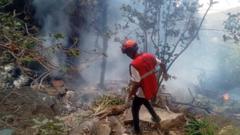

NAIROBI, KENYA — In a tragedy that has sent reverberations across diplomatic and intelligence circles globally, a catastrophic helicopter crash in remote Kenya has claimed the lives of seven individuals, prominently including Ecuador’s chief intelligence official, Michele Sensi-Contugi, and his American wife, Stephany Hollihan. The incident, which occurred under circumstances currently undergoing rigorous international scrutiny, has immediately triggered complex geopolitical questions, investigations into aviation safety standards in East Africa, and profound mourning within the intelligence communities of South America and North America.
The crash site, situated in a challenging geographical expanse within Kenya, became the focal point of an intensive rescue and recovery operation involving local emergency responders and international aviation authorities. According to preliminary incident reports gathered by Sierraleo News Network correspondents on the ground, the aircraft went down unexpectedly, leaving no survivors among the occupants. The presence of high-ranking foreign intelligence personnel aboard a domestic or regional flight path immediately elevated the accident from a standard aviation tragedy to an event of significant geopolitical interest, prompting immediate high-level diplomatic communications between the governments of Kenya, Ecuador, and the United States.
Michele Sensi-Contugi was not merely a bureaucrat; he was a central figure in Ecuador’s contemporary security apparatus. As the head of the country's national intelligence agency, Sensi-Contugi occupied a pivotal role in the administration's ongoing struggle against powerful transnational criminal syndicates, drug trafficking cartels, and internal civil unrest. His presence in East Africa, alongside American citizens—including his wife Stephany Hollihan—has ignited a flurry of speculation regarding the nature of his mission. While official statements have yet to confirm the exact purpose of the travel, regional security analysts suggest that intelligence sharing, counter-narcotics cooperation, or strategic security dialogues may have been on the agenda, given the expanding footprint of international crime syndicates operating across Latin America, Europe, and Africa.
Geopolitical Implications and the Nexus of Transnational Intelligence
To fully comprehend the gravity of Sensi-Contugi’s death, one must examine the broader geopolitical landscape in which Ecuador currently finds itself. Over the past half-decade, the Andean nation has transitioned from being a relatively stable transit country for narcotics to a frontline battleground for violent, militarized cartels with deep international connections. Sensi-Contugi was tasked with navigating this treacherous environment, dismantling clandestine financial networks, and forging international alliances to stem the flow of illicit cocaine destined for North American and European markets.
The inclusion of five American citizens among the fatalities introduces another layer of complexity. The United States has maintained a robust, albeit often discreet, security partnership with Ecuador, providing technical assistance, intelligence-gathering capabilities, and specialized training to combat domestic insurgencies and cartel violence. The loss of American lives in the same incident underscores the deep, operational entanglement between American intelligence liaisons and their Ecuadorian counterparts. Analysts point out that when intelligence chiefs travel abroad with American personnel, the missions are rarely routine; they frequently involve sensitive diplomatic signaling, joint strategic planning, or coordination on high-stakes counter-terrorism and counter-narcotics initiatives.
Furthermore, Kenya’s role as the backdrop for this tragedy cannot be overlooked. Kenya has long positioned itself as the diplomatic, economic, and logistical hub of East Africa, hosting numerous international organizations, foreign embassies, and regional security headquarters. It is frequently utilized as a neutral meeting ground for multinational delegations, counter-terrorism task forces, and diplomatic missions. However, the East African region itself faces severe security challenges, ranging from regional insurgencies to complex logistical hurdles in remote aviation corridors. The convergence of Ecuadorian intelligence leadership and American citizens in Kenya highlights the increasingly globalized nature of modern security networks, where threats and partnerships transcend traditional geographic boundaries.
Aviation Safety and the Mechanics of the Crash
Beyond the diplomatic and intelligence ramifications, the incident places a harsh spotlight on aviation safety standards within regional African transport corridors. Helicopters operating in East Africa frequently contend with unpredictable weather patterns, high-altitude terrain, rapidly shifting microclimates, and logistical challenges regarding maintenance infrastructure. While aviation authorities in Kenya, in collaboration with international bodies such as the International Civil Aviation Organization (ICAO), have initiated a comprehensive forensic investigation into the wreckage, initial findings may take weeks or even months to materialize.
Aviation experts emphasize that investigating a crash involving high-profile foreign intelligence personnel inherently requires heightened security protocols. Investigators must determine whether the catastrophe was the result of mechanical failure, pilot error, severe weather phenomena, or external interference. Given Sensi-Contugi's sensitive professional background, conspiracy theories and premature speculations are bound to circulate in the public sphere; however, professional investigators urge caution, noting that the vast majority of such incidents in remote regions ultimately stem from a combination of environmental hazards and mechanical variables.
The wreckage recovery process has been described by local authorities as painstakingly difficult. Rugged terrain, combined with limited immediate communications infrastructure in the immediate vicinity of the impact zone, hampered the initial deployment of search and rescue teams. Kenyan emergency services, alongside specialized military units, mobilized quickly once the distress signal was verified, but the remote nature of the location meant that survival probabilities were virtually nonexistent by the time the first responders reached the site.
Economic and Domestic Political Aftershocks in Ecuador
Inside Ecuador, the news of Sensi-Contugi’s sudden death has plunged the political establishment into a state of shock and strategic uncertainty. The national intelligence agency operates as a critical pillar of state security, particularly under a state of internal armed conflict declared by the government to combat heavily armed domestic gangs. The sudden decapitation of this agency's leadership creates an immediate institutional vacuum.
Economic analysts watching Ecuador note that national security and economic stability are inextricably linked. The persistent threat of cartel violence has severely damaged investor confidence, disrupted local commerce, and drained state resources toward militarized containment. Sensi-Contugi was viewed by many as a steady, reform-minded technocrat attempting to modernize Ecuador’s intelligence architecture to meet twenty-first-century transnational threats. His unexpected removal from the political chessboard forces the administration of President Daniel Noboa to urgently identify and vet a successor capable of commanding the trust of both domestic security forces and vital international allies, notably the United States.
Moreover, the presence of his wife, Stephany Hollihan, among the victims adds a profoundly human and tragic dimension to the national mourning. Diplomatic missions in Quito have lowered their flags to half-mast, and condolences have poured in from regional capitals across South America, reflecting the cross-border impact of the tragedy.
The American Response and Transnational Oversight
In Washington, the Department of State and relevant defense agencies are quietly managing the fallout of the tragedy. While formal statements of condolence have been issued, deep-dive briefings are undoubtedly underway behind closed doors. The deaths of five American citizens in a foreign helicopter crash alongside a foreign intelligence chief necessitate standard consular assistance, but the intelligence community will also conduct its own internal reviews regarding operational security, travel safety protocols, and the nature of the engagement in Kenya.
U.S. lawmakers and security committees frequently scrutinize foreign deployments of this nature. The incident serves as a stark reminder of the hidden risks borne by civilian and military personnel operating in complex international environments. Whether these individuals were operating under official diplomatic cover, private security contractors, or specialized liaison capacities, their loss underscores the invisible risks taken daily by those maintaining the architecture of global security alliances.
International relations scholars point out that joint operations between the United States and Latin American nations have faced renewed scrutiny in recent years, particularly concerning sovereignty, human rights, and the militarization of domestic law enforcement. Despite these debates, pragmatic cooperation against transnational organized crime remains deeply entrenched. The tragedy in Kenya highlights the human cost of this continuous, shadow-world collaboration.
Regional Perspectives from East Africa
Within Kenya, the incident has drawn intense local media coverage and sparked discussions regarding the country's growing role as a magnet for international diplomatic and security personnel. Kenya’s civil aviation authorities have pledged full transparency, committing to share the black box data and forensic analysis with international counterparts from Ecuador and the United States.
East African geopolitical analysts note that Kenya frequently absorbs the operational friction of international geopolitics. Because Nairobi hosts major United Nations offices, international NGOs, and foreign intelligence listening posts, the country is regularly the transit point for high-level delegations moving between the Global South and the West. While local authorities maintain strict regulatory oversight over commercial aviation, private and chartered flights utilized by high-profile foreign dignitaries sometimes operate under distinct logistical frameworks, prompting calls from local aviation unions for stricter standardization across all charter operations within national airspace.
Furthermore, the swift response by Kenyan security forces has been praised by foreign embassies in Nairobi, demonstrating the host nation's capability and commitment to managing international crises efficiently, even when they involve sensitive foreign intelligence figures.
Future Consequences and Long-Term Outlook
As the investigation grinds forward, the long-term consequences of this crash will likely ripple across multiple domains. First, intelligence cooperation between Ecuador and its international partners will face a transitional period. The institutional knowledge lost with Sensi-Contugi’s death cannot be easily replaced, requiring his successor to undergo a steep learning curve while managing an active domestic security crisis.
Second, global intelligence and diplomatic agencies will undoubtedly review their travel and transport safety guidelines. The use of chartered helicopters in developing nations or regions with challenging topography will be subjected to enhanced risk assessments. High-ranking officials may face stricter limitations on traveling together on single aircraft, a standard risk-mitigation procedure that is sometimes relaxed during delicate, fast-moving diplomatic missions.
Third, the public appetite for transparency regarding the exact mission parameters will persist. While intelligence agencies naturally operate behind a veil of secrecy, the extraordinary circumstances of a national intelligence director dying alongside foreign citizens in a remote African nation invite sustained journalistic inquiry. Governments in Quito, Washington, and Nairobi will be pressured to release as much forensic and contextual information as national security parameters permit to quell speculation and honor the victims.
In conclusion, the tragic helicopter crash in Kenya is far more than a localized aviation accident. It represents a profound human loss and a disruptive geopolitical event that intersects the worlds of intelligence, international diplomacy, transnational crime-fighting, and aviation safety. As forensic teams sift through the debris in Kenya, and as governments in South America and North America grapple with the institutional void left behind, the true dimensions of this tragedy will continue to unfold, reminding the global community of the fragile and interconnected nature of modern statecraft.